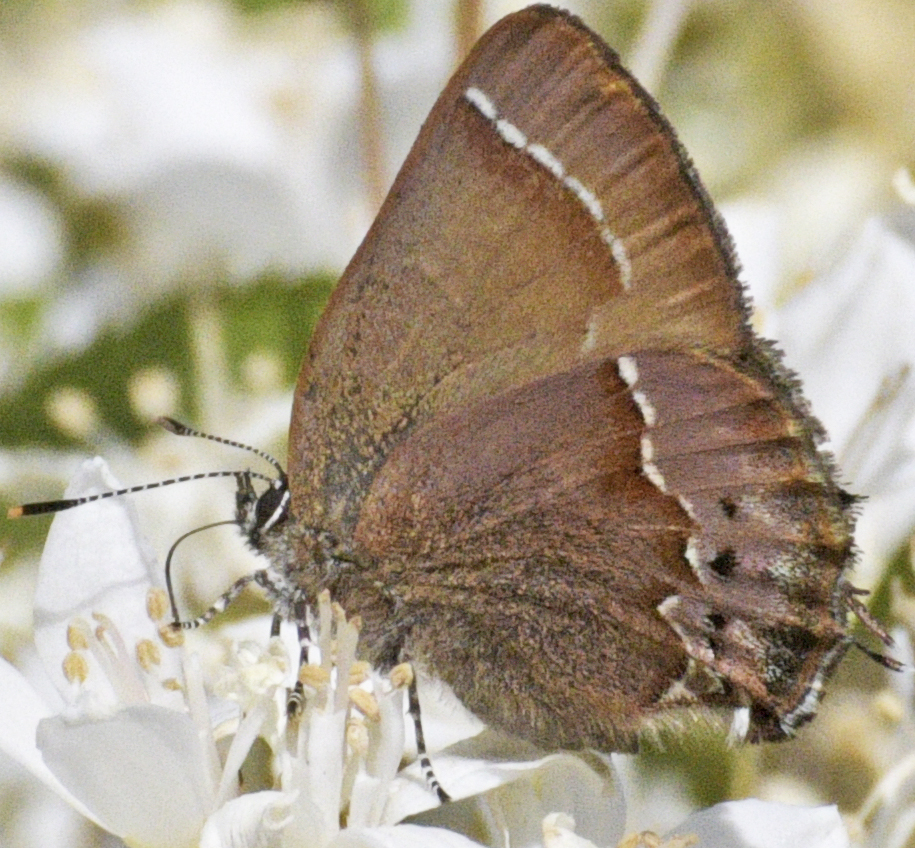
Observation date: May 09, 2025
Submitted by: sandyleapt
Specimen type: Photograph
Observation notes: I am not absolutely positive about this identification, of the three semi-lookalike hairstreaks this seems like the most logical species to find in my garden. Although, occasionally the east wind brings me a surprise down the Columbia River Gorge.
One small (slightly larger than a grey Hairstreak) butterfly nectaring in my garden on a deutzia shrub that is in full bloom right now. We are having a very warm dry spring, which may lead to a great butterfly year in the neighborhood. There are Western Red Cedar trees growing a couple blocks from my house in a small natural area that includes a swampy little stream.
Status: Nonresident
Verified by: Ken Davenport
Verified date: May 11, 2025
Coordinator notes: I agree with your apprehension of making identifications of nelsoni or gryneus in your submission. In my area Callophrys nelsoni acts like a different species than Callophrys "siva" juniperaria which occurs on junipers while nelsoni flies at higher elevations on Incense Cedar in the Greenhorn Mountains in California. If your Cedars were incense Cedars you could call them nelsoni, but based on Jonathan Pelhams observations in your area "gryneus (including siva) act as a single species in your area. Muir's Hairstreaks use Sargent Cypress. And muiri populations genomics can be interpreted as either muiri a species or southern California ones seem closest to nelsoni genomically. And your upperside photo rules out Callophrys johnsoni which I doubt would stray into residential areas. Callophrys "siva" (most call them gryneus (which may not be true based on allozyme research) does have brown subspecies like chalcosiva. -Ken Davenport