
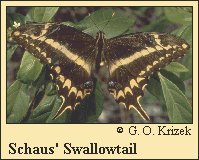
Schaus' Swallowtail
Papilio aristodemus Esper, 1794
Family: Papilionidae
Subfamily: Papilioninae
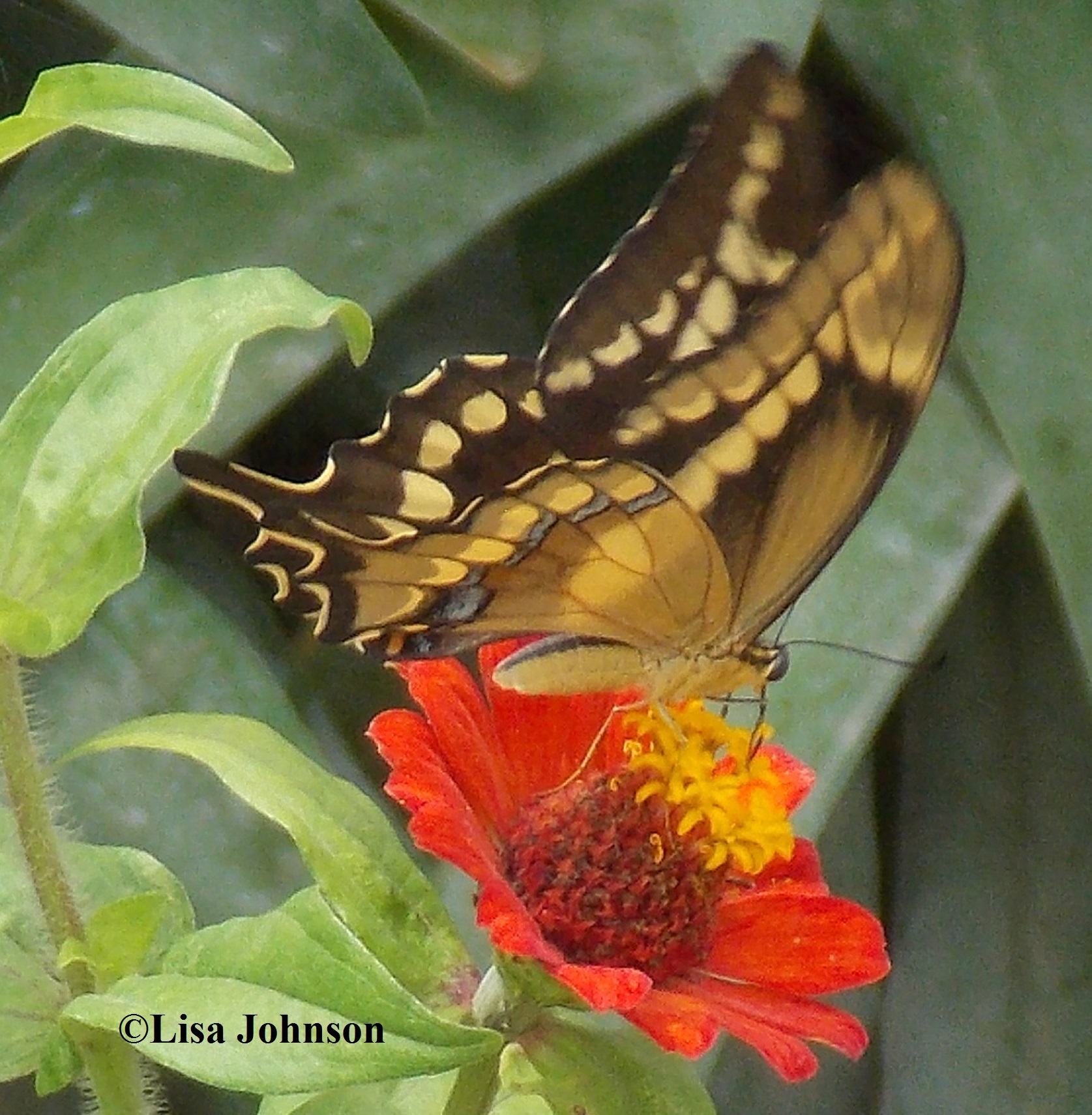
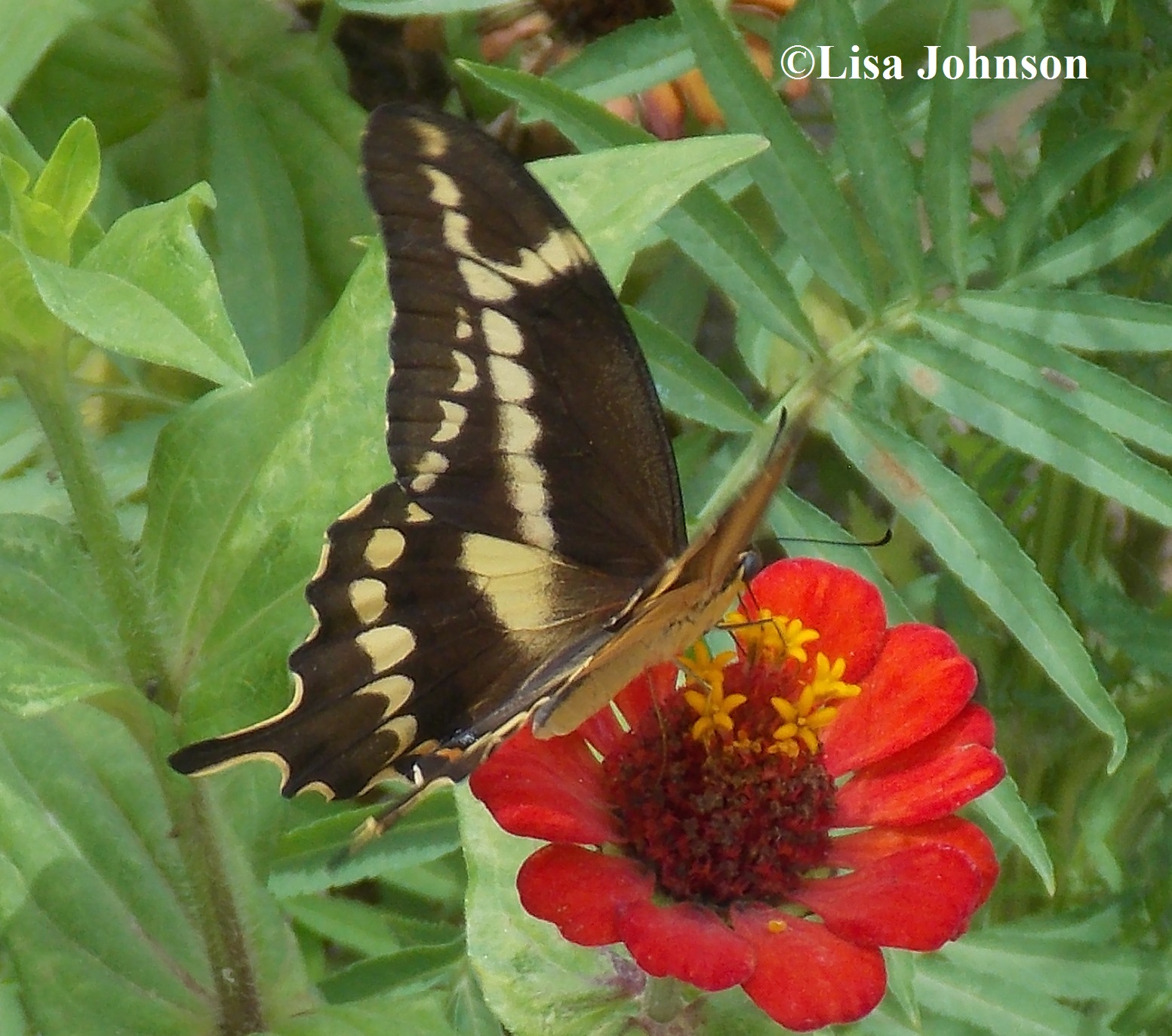
Identification: Upperside of forewing has narrow central yellow band. Tails edged with yellow, filled with black.
Wing Span: 3 5/8 - 4 5/8 inches (9.2 - 11.8 cm)
Life History: Males patrol in tree canopy for receptive females. Females lay single eggs on top of young host plant leaves. Caterpillars feed on young leaves and shoots. Hibernate as chrysalids, which can remain dormant for up to 2 years. Adult emergence is triggered by rainfall.
Flight: Primary flight from late April to mid-June; some adults fly in late July and early September.
Caterpillar Hosts: Plants in the citrus family (Rutaceae) including Citrus species, hop tree (Ptelea trifoliata), Zanthoxylum spp., and torchwood (Amyris elemifera).
Adult Food: Nectar from flowers of cheese-shrub, wild coffee, and guava.
Habitat: Found only in tropical hardwood hammocks and neighboring scrub areas.
Range: North Key Largo and the larger Keys in Biscayne National Monument (subspecies ponceanus), south to the Greater Antilles (other subspecies).
Conservation: Listed in 1984 as Endangered by the U.S. Fish and Wildlife Service under the Endangered Species Act.
NCGR: Subspecies ponceanus has The Nature Conservancy Global Rank of T1 - Critically imperiled globally because of extreme rarity (5 or fewer occurrences, or very few remaining individuals), or because of some factor of its biology making it especially vulnerable to extinction. (Critically endangered throughout its range). The species as a whole has The Nature Conservancy Global Rank
Management Needs: For subspecies ponceanus, maintain hardwood hammocks on upper keys, prevent mosquito fogging, and reintroduce to vacant habitats.
Comments: NULL


Please donate!
We depend on donations to keep Butterflies and Moths of North America freely available. We want to express our gratitude to all who showed their support by making a contribution this year. You can donate to support this project at any time.
Advertise with us!
Do you have a product or service that you think would interest BAMONA users? If you would like to advertise on this website, contact us by email, or use the contact form and select the "Advertising" category.
Verified Sightings
Displaying 1 - 16 of 16 verified sightings

Observation date: May 09, 2024
Submitted by: dvollmar
Region: Monroe County, Florida, United States
Verified by: John Calhoun
Verified date: Aug 08, 2024

Observation date: May 23, 2022
Submitted by: ncrosbyrd
Region: Monroe County, Florida, United States
Verified by: John Calhoun
Verified date: Jun 02, 2022

Observation date: May 24, 2022
Submitted by: ncrosbyrd
Region: Monroe County, Florida, United States
Verified by: John Calhoun
Verified date: Jun 02, 2022

Observation date: May 19, 2017
Submitted by: Mark Salvato
Region: Monroe County, Florida, United States
Verified by: John Calhoun
Verified date: Nov 19, 2021

Observation date: May 06, 2015
Submitted by: LLJohnson
Region: Dominican Republic
Verified by: M. Reith
Verified date: Jan 12, 2017

Observation date: Nov 24, 2014
Submitted by: LLJohnson
Region: Dominican Republic
Verified by: M. Reith
Verified date: Apr 02, 2015

Observation date: Aug 04, 2014
Submitted by: LLJohnson
Region: Dominican Republic
Verified by: M. Reith
Verified date: Mar 23, 2015
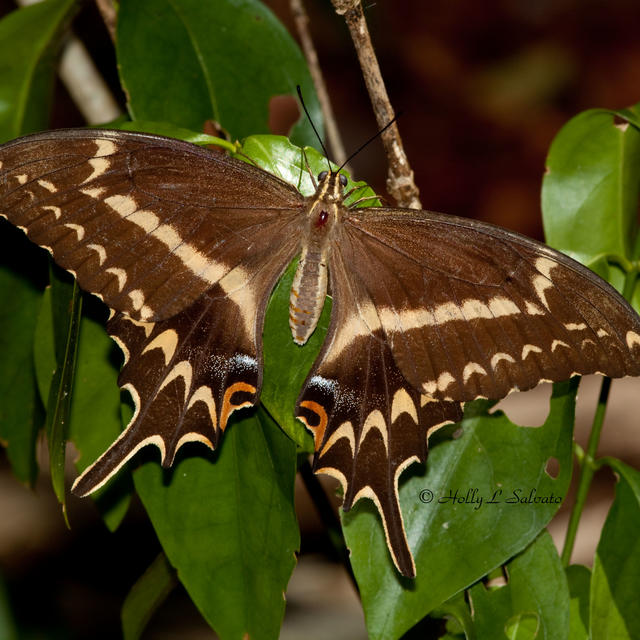
Observation date: May 24, 2014
Submitted by: Mark Salvato
Region: Miami-Dade County, Florida, United States
Verified by: John Calhoun
Verified date: May 29, 2014

Observation date: Jun 15, 2013
Submitted by: LLJohnson
Region: Dominican Republic
Verified by: BAMONA
Verified date: Jun 23, 2013

Observation date: unknown
Submitted by: BAMONA (George O. Krizek)
Region: United States
Verified by: BAMONA
Verified date: Sep 06, 2010

Observation date: unknown
Submitted by: legacy.reporter
Region: Matecumbe Key County, Florida, United States
Verified by: legacy.verifier
Verified date: Dec 31, 2004
Observation date: unknown
Submitted by: legacy.reporter
Region: Eliott Key County, Florida, United States
Verified by: legacy.verifier
Verified date: Dec 31, 2004
Observation date: unknown
Submitted by: legacy.reporter
Region: Key West County, Florida, United States
Verified by: legacy.verifier
Verified date: Dec 31, 2004
Observation date: unknown
Submitted by: legacy.reporter
Region: Miami-Dade County, Florida, United States
Verified by: legacy.verifier
Verified date: Dec 31, 2004
Observation date: unknown
Submitted by: legacy.reporter
Region: Key Largo County, Florida, United States
Verified by: legacy.verifier
Verified date: Dec 31, 2004
Observation date: unknown
Submitted by: legacy.reporter
Region: Monroe County, Florida, United States
Verified by: legacy.verifier
Verified date: Dec 31, 2004