
Mary's Giant-Skipper
Agathymus mariae (Barnes & Benjamin, 1924)

Family: Hesperiidae
Subfamily: Megathyminae
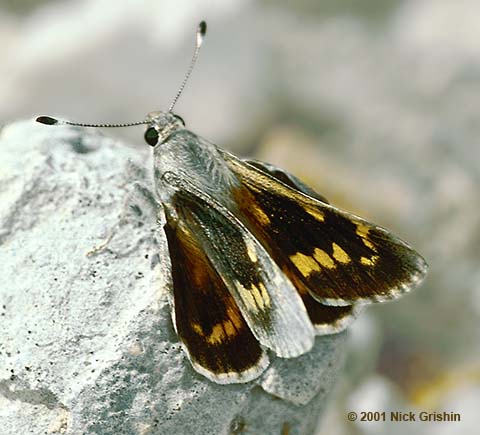
Identification: Upperside is black-brown with olive scales at the wing bases. Both wings have bands of yellow spots separated by black veins; spot bands of the female are wider. Underside of hindwing is gray with faint dark markings and a sometimes vague light-colored band.
Wing Span: 1 5/8 - 1 7/8 inches (4.2 - 4.8 cm).
Life History: From early morning to noon males perch near host plants to wait for receptive females. Eggs are laid singly on the host and fall to the base of the plant. A young caterpillar crawls to a leaf tip and burrows inside where it eats pulp and then hibernates. In the spring the caterpillar makes a new burrow in a leaf base where it feeds on sap until becoming inactive in the summer. Before pupating, the caterpillar enlarges the opening of its burrow and makes a silk trap door from which the adult can emerge.
Flight: One brood from September-November.
Caterpillar Hosts: Lechuguilla (Agave lechuguilla).
Adult Food: Females do not feed; males sip moisture from mud.
Habitat: Thorn forest and desert hills.
Range: Southern New Mexico, west Texas, and northern Mexico.
Conservation: Not usually required.
NCGR: G3 - Very rare or local throughout its range or found locally in a restricted range (21 to 100 occurrences). (Threatened throughout its range).
Management Needs: None reported.
Comments: NULL


Please donate!
We depend on donations to keep Butterflies and Moths of North America freely available. We want to express our gratitude to all who showed their support by making a contribution this year. You can donate to support this project at any time.
Advertise with us!
Do you have a product or service that you think would interest BAMONA users? If you would like to advertise on this website, contact us by email, or use the contact form and select the "Advertising" category.
Verified Sightings
Displaying 1 - 19 of 19 verified sightings

Observation date: unknown
Submitted by: BAMONA
Region:
Verified by: BAMONA
Verified date: Sep 06, 2010

Observation date: unknown
Submitted by: nick.grishin (Nick Grishin)
Region: Texas, Terrell County, United States
Verified by: BAMONA
Verified date: Sep 06, 2010

Observation date: unknown
Submitted by: legacy.reporter
Region: Texas, Kinney County, United States
Verified by: legacy.verifier
Verified date: Dec 31, 2004
Observation date: unknown
Submitted by: legacy.reporter
Region: Hudspeth County, Texas, United States
Verified by: legacy.verifier
Verified date: Dec 31, 2004
Observation date: unknown
Submitted by: legacy.reporter
Region: Texas, Presidio County, United States
Verified by: legacy.verifier
Verified date: Dec 31, 2004
Observation date: unknown
Submitted by: legacy.reporter
Region: Doña Ana County, New Mexico, United States
Verified by: legacy.verifier
Verified date: Dec 31, 2004
Observation date: unknown
Submitted by: legacy.reporter
Region: Texas, Terrell County, United States
Verified by: legacy.verifier
Verified date: Dec 31, 2004
Observation date: unknown
Submitted by: legacy.reporter
Region: Chaves County, New Mexico, United States
Verified by: legacy.verifier
Verified date: Dec 31, 2004
Observation date: unknown
Submitted by: legacy.reporter
Region: Culberson County, Texas, United States
Verified by: legacy.verifier
Verified date: Dec 31, 2004
Observation date: unknown
Submitted by: legacy.reporter
Region: Texas, Uvalde County, United States
Verified by: legacy.verifier
Verified date: Dec 31, 2004
Observation date: unknown
Submitted by: legacy.reporter
Region: Chihuahua, Mexico
Verified by: legacy.verifier
Verified date: Dec 31, 2004
Observation date: unknown
Submitted by: legacy.reporter
Region: Brewster County, Texas, United States
Verified by: legacy.verifier
Verified date: Dec 31, 2004
Observation date: unknown
Submitted by: legacy.reporter
Region: Otero County, New Mexico, United States
Verified by: legacy.verifier
Verified date: Dec 31, 2004
Observation date: unknown
Submitted by: legacy.reporter
Region: Texas, Val Verde County, United States
Verified by: legacy.verifier
Verified date: Dec 31, 2004
Observation date: unknown
Submitted by: legacy.reporter
Region: El Paso County, Texas, United States
Verified by: legacy.verifier
Verified date: Dec 31, 2004
Observation date: unknown
Submitted by: legacy.reporter
Region: Texas, Reeves County, United States
Verified by: legacy.verifier
Verified date: Dec 31, 2004
Observation date: unknown
Submitted by: legacy.reporter
Region: Coahuila De Zaragoza, Mexico
Verified by: legacy.verifier
Verified date: Dec 31, 2004
Observation date: unknown
Submitted by: legacy.reporter
Region: Texas, Pecos County, United States
Verified by: legacy.verifier
Verified date: Dec 31, 2004
Observation date: unknown
Submitted by: legacy.reporter
Region: Eddy County, New Mexico, United States
Verified by: legacy.verifier
Verified date: Dec 31, 2004